JoyZine


The Search For Dinosaurs
Giclee Print

Payne, Roger
Buy at AllPosters.com

A Fossilized Dinosaur Egg, Probably of the Sauropod Hypselosaurus
A Fossilized Dinosaur Egg
Giclee Print
Buy This at Allposters.com

Pterodactylus Kochi
Pterodactylus Kochi
Clive Nolan—Photographic Print
Buy This at Allposters.com

Sand Goanna (Veranus Gouldii), Sturt National Park, New South Wales, Australia
Sand Goanna, Sturt NP, NSW
Mitch Reardon—Photo Print
Buy This at Allposters.com

Pteranodon
Pteranodon
Payne
Buy This at Allposters.com


Australian Megafauna


Tools
Search Dictionary

Instructions
Help, Hints & Tips
Conversions
Convert Currency
Convert Temperature
Maps
Australia
Queensland
Northern Territory
New South Wales
South Australia
Tasmania
Western Australia


Google
Search WWW Search artistwd.com

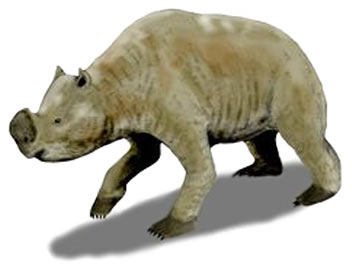
Zygomaturus
Zygomaturus tasmanicus

Zygomaturus tasmanicus

Zygomaturus is an extinct, giant marsupial from Australia's Pleistocene age. The scientific name refers to the broad zygomatic arches (cheek bones) and the three prominent lobes of the premolar teeth.

It had a heavy body and thick legs and is believed to have been similar to the modern pygmy hippopotamus in both size and build. The adult Zygomaturus was about 2.5 metres long and about 1 metre high at the shoulder, with a weight of 300-500 kilograms.

They were four-footed herbivores that might have overlapped in their dietary preferences with the larger kangaroos. Competition with the kangaroos for food might have contributed to the extinction of Zygomaturus and Diprotodon.

It lived in the wet coastal margins of Australia about 19,000 years ago, restricted to south-eastern and south-western Australia, unlike its close relative, the more widely ranging Diprotodon. This range restriction reflected the preference of Zygomaturus for lush, forested habitats in contrast to the open plains and arid regions favoured by Diprotodon.

Some believe that Zygomaturus may have expanded its range toward the interior of the continent along the waterways. It is believed to have lived in small herds. Zygomaturus probably ate reeds and sedges by shoveling them up in clumps with its lower incisor teeth.

A Zygomaturus skeleton was donated to the museum early in the 20th century by the Queen Victoria Museum and Art Gallery in Launceston, Tasmania. Staff from that museum collected the specimen from Mowbray Swamp near Smithton, Tasmania, a Zygomaturus graveyard that has produced the most complete skeletons of this animal.

Like the other megafaunal giants, Zygomaturus became extinct around 50,000 years ago.


Back to Top
Contact | Site Map | Links | Privacy |
Site designed & maintained by Artist Web Design
Copyright © 1996-2012