JoyZine


Aborigine Dance
Aborigine Dance
Giclee Print—
Brook, Robert
Buy at AllPosters.com

Aborigines in an Australian Landscape
Aborigines in an Australian Landscape Giclee Print—Rowe, George
Buy at AllPosters.com

Aborigines
Aborigines
Mcbride
Buy This at Allposters.com

Aborigines under Attack
Mcbride
Buy This at Allposters.com

Warriors of New South Wales, engraved by Matthew Dubourg
Warriors of New South Wales
John Heaviside—Giclee Print
Buy This at Allposters.com

The Aboriginal Inhabitants: from South Australia Illustrated, Published in 1847
Giclee Print—Angas, George...
Buy at AllPosters.com

Port Jackson, New Holland: Aboriginal Family 1817-20
Port Jackson, New Holland,
Aboriginal Family 1817-20
Giclee Print—Leroy, Sebastien
Buy at AllPosters.com

The Aboriginal Inhabitants: The Kuri Dance, from South Australia Illustrated, Published in 1847
The Kuri Dance, from South Australia Illustrated, Published in 1847
Giclee Print—Angas, George...
Buy at AllPosters.com

Carved and Decorated Aboriginal Tools
Giclee Print

Buy at AllPosters.com

Aboriginal Painting
Aboriginal Painting
John Newcomb—Giclee Print
Buy This at Allposters.com

Title Page of 'South Australia Illustrated', 1846-7
Title Page of South Australia Illustrated, 1846-7
Giclee Print
Buy This at Allposters.com


Rubies of Mogok


Tools
Search Dictionary

Instructions
Help, Hints & Tips
Conversions
Convert Currency
Convert Temperature
Maps
Australia
Queensland
Northern Territory
New South Wales
South Australia
Tasmania
Western Australia


Google
Search WWW Search artistwd.com

Bringing them home:
the 'Stolen Generation' report

The Stolen Generation


"Almost half of the Aboriginal people who died in custody and were investigated by the Black Deaths Royal Commission, had been removed from their families as children..."

- Kirsten Garrett, Background Briefing, Sunday, 11 February 1996.

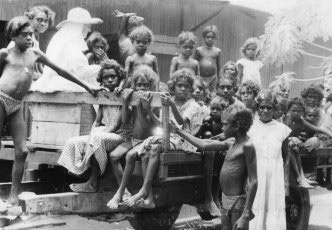
The 'Stolen Generation' is the expression used to describe the Aboriginal people of Australia who were forcibly removed from their families as children between 1900s and the 1960s, to be brought up by white foster families or institutions.

The practice became commonplace and, in fact, government policy, as did the wide-spread killing of Aboriginal people. "The newspapers, the parliamentary Hansards, the diaries which set out the Australian record plainly and clearly in black and white show beyond doubt that most whites on the frontier were well aware that Aboriginal people were being murdered in very large numbers," states historian Professor Marcia Langton. Removal of Aboriginal children was still taking place well into the 1960s and ‘70s, especially if they were light-skinned or mixed-race.

Mothers smeared their children with black clay, or held them over a fire to try to darken their skin, or hid them in hollow logs to avoid "welfare" workers from taking their children. "Good intentions were there (on the part of church and state], but behind that, particularly in the 1930s and right through to the 1940s was this quite deliberate plan to breed the Aborigines out.

"The National Inquiry into the Separation of Aboriginal and Torres Strait Islander Children from Their Families was established in May 1995 in response to efforts made by key indigenous agencies and communities. They were concerned that the general public's ignorance of the history of forcible removal was hindering the recognition of the needs of its victims and their families and the provision of services.

A key turning point was the 1994 Going Home Conference in Darwin. Represen-tatives from every state and territory met to share experiences, to bring to light the history and its effects in each jurisdiction and to devise strategies to meet the needs of those children and their families who survive.On 11 May 1995, the then Attorney-General, Michael Lavarch MP, referred the issue of past and present practices of separation of Indigenous children from their families to the Commission.

Public evidence was taken from Indigenous organisations and individuals, state and territory government representatives, church representatives, other non-government agencies, former mission and government employees and individual members of the community. Confidential evidence was taken in private from Indigenous people affected by forcible removal and from adoptive and foster parents. Many people and organisations made written submissions to the Inquiry, including many who also gave oral evidence.


The Stolen Generations report can be downloaded as a series of PDF files:

Get Adobe Reader To view the Portable Document Format files (PDFs) on this site, download a free Acrobat Reader, which allows you to view, navigate and print PDF files across many different platforms. If you wish to download a copy of the free Adobe Acrobat Reader please click on the "Get Acrobat" icon.


Back to Top
Contact | Site Map | Links | Privacy |
Site designed & maintained by Artist Web Design
Copyright © 1996-2012