
| Search JoyZine with Google Site Search! |
Australia Decoded
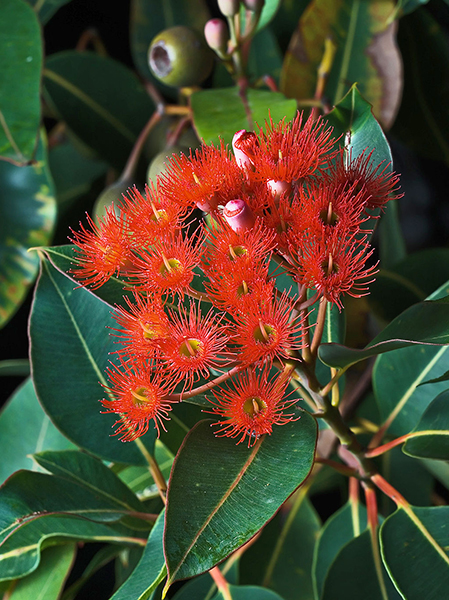
red-backed fairy-wren—Malurus melanocephalus, an attractive, small, black wren with a bright red back. It is common in central Cape York Peninsula woodland, especially near water. Very common in the Kimberley. This is the smallest (12cm—13cm) of the fairy-wrens, the jenny being the only female fairy-wren with no blue in the tail. Insect-eater. The nest is dome-shaped, with a large entranceway in the side towards the top. It is constructed of dried grasses bound by spider webbing, and lined with finer grass and plant down. The nest is usually close to the ground—at heights from 0.2m—0.8m—in grass tufts, thick grass or low vegetation, sometimes over water. Breeding is generally from July to February, but may extend to other months, with two to four eggs laid. Congregates in pairs or family parties, preferring grasslands and open forests, but does frequent the edges of rainforest and sometimes mangroves. Often found in the rank vegetation of swamplands. The male has been seen to carry red or brightly coloured petals in its beak to enhance the display for the female during courtship. red-backed kingfisher—Halcyon pyrrhopygius, a relatively small Australian kingfisher, it is named for its distinctive reddish-brown lower back and rump. It is also easily distinguished from other kingfisher species by the green and white streaks on its crown. The adult male red-backed kingfisher has a dark green upper back, sometimes with whitish edges to some of the feathers, giving a streaky appearance. The wings and tail are blue, while the cheeks, throat and underparts are white and there is a white collar around the neck. The red-backed kingfisher has a white forehead and a white line above the eye, contrasting with a black band that runs through the eye to the back of the neck. The females similar in appearance to the male, but is duller overall, with a streakier crown and a buffy tinge to the collar and flanks. Both sexes have a greyish-black beak that has a large yellowish area on the lower mandible. The red-backed kingfisher's eyes are dark brown and its legs and feet are greyish to black. Juvenile red-backed kingfishers resemble the adult female, but have a reddish-buff hindneck and flanks, and narrow dark tips on the neck and breast feathers. A rather quiet and unobtrusive kingfisher species, the red-backed kingfisher usually calls with a short, mournful whistle, described as 'pee-eee', which may be repeated monotonously every few seconds. When alarmed, this species gives a whistle or a harsh, chattering call. Also known as golden kingfisher, red-rumped kingfisher. red-bellied black snake—Pseudechis porphyriacus, a medium-sized snake, with a moderate to robust build and head barely distinct from the neck. Dorsal head and body colour is uniform black, except for the snout which is often pale brown. The lowest lateral scale rows and the outer edge of the ventral scales are bright crimson, fading to duller red, orange or pink in the middle of the belly. In the north of the range the ventral colour may be greyish-pink to white. The underside of the tail is black. Body scales are smooth and glossy. Eyes are medium size and shadowed by an obvious brow-ridge. The iris is very dark, and the pupil is round. The average adult size is 1.5-2m, with males growing slightly larger than females. Red-bellied black snakes occur disjunctly in northern and central eastern Queensland and then more continuously from south-eastern Queensland through eastern New South Wales and Victoria. Another disjunct population occurs at the southern end of the Mount Lofty Ranges in South Australia. This species is usually associated with moist habitat, primarily streams, swamps and lagoons, within forests, woodlands and grasslands. The snakes shelter in thick grass clumps, logs, mammal burrows and dreys, and under large rocks. Red-bellied black snakes feed on a variety of vertebrates including fish, tadpoles, frogs, lizards, snakes (including its own species) and mammals. Courtship and mating among occurs primarily in spring (early October to November), although it may begin as early as late winter. Males travel widely in search of receptive females and will engage in combat with any rival male that they encounter. Four to five months after mating the female gives birth to between 5 and 18 young that are born enclosed in a membranous sac. They emerge from the sac soon after birth (although they can remain inside for up to two days), and measure around 28cm in total length. Red-bellied black snakes are the only species in the genus Pseudechis that have live young. During long periods of drought, reproduction may be limited or even cease altogether. Red-bellied black Snakes are one of the most frequently encountered snakes on the east coast of Australia, and are responsible for a number of bites every year. They are a shy snake and will generally only deliver a serious bite under severe molestation. If unable to escape, the snake will rear up with its head and forebody held off but parallel to the ground, spread its neck and hiss loudly, and may even make mock strikes with a closed mouth. Some individuals will lay low and slowly undulate their tail in a fashion similar to many lizards, presumably to draw attention away from the vulnerable head. Further harassment will cause the snake to lash out and deliver a rapid (but often clumsy) bite, and sometimes they may hang on and chew savagely. The venom has predominantly anticoagulant and myotoxic effects, and symptoms of envenomation include bleeding and/or swelling at the bite site, nausea, vomiting, headache, abdominal pain, diarrhoea, sweating, local or general muscle pain and weakness, and red-brown urine (due to myoglobin being released from damaged muscle tissue). For its size, the red-bellied black snake is probably the least dangerous elapid snake in Australia. red-browed firetail—Emblema oculata, a medium-sized finch. Males have olive-brown head, back and wings with fine, black barring. The rump, upper tail coverts and tail edges are crimson. The lores and forehead is black with a blue periopthalmic ring. The lower breast, belly and undertail coverts black with large white spots. The bill and eyes are red, the feet and legs grey-brown. Shy and elusive, this firetail occupies permanent territories in mated pairs. It is rarely seen on the ground, with foraging occurring mostly in bushes, trees and shrubs. Inhabits dense temperate heath, swamps and moist melaleuca thickets, occupying the same ecological niche as the beautiful firetail does in the east. Breeding: September-January. The nest is horizontal and flask shaped, with a side entrance (tunnel), approximately 350mm long x 150mm wide and located high in a tree or shrub. Construction is mostly from grass and the lining from feathers. The male collects nesting materials whilst the female constructs the nest. Both sexes incubate the clutch and rear the young. Status: in the wild, uncommon to rare. Distribution: south-western Western Australia. Also known as red-eared finch, red-eared firetail. red-brown earths—developed commonly on slates, shales and granites and on areas of old alluvium that are now above the level of modern floods. They have brown to grey-brown, loam to sandy-loam, surface soil overlying a reddish-brown clay subsoil. The surface soil is mildly acidic, but the acidity diminishes with depth, and concretions of calcium carbonate are present in the deeper layers. The organic matter is concentrated in the surface soil, and where this has been lost by erosion fertility falls. The soils are well supplied with potassium, calcium and magnesium, but are always deficient in phosphorus and nitrogen. They are widely used for cereal production in the winter rainfall regions of southern Australia, and in New South Wales and Victoria have been extensively irrigated for pasture and horticultural production. red-capped robin—Petroica goodenovii, a small, attractive bird, characteristically tame and easy to approach. They are constantly on the move and often catch insects on the wing, or with quick darts to the ground. Like most robins, even when perched they regularly give flicks of their wings and tail feathers. With their bright red forehead and breast, adult male red-capped robins are easily distinguished from the brown females and immature males. Adult males, however, often try to reduce the visibility of their distinctive colouring by sitting with their backs to observers. Widespread across inland Australia below the tropics, it is generally associated with semi-arid areas and is common in mulga, mallee and cypress pine woodlands. Many Aboriginal groups have stories to explain its distinctive markings. red-cheeked dunnart—Sminthopsis virginiae, a burrowing, low woodland, terrestrial, insectivorous, nocturnal marsupial, so called because of the distinctive red hair on its cheek. It holds three subspecies that occur in many areas within its range. It prefers habitats within savannah grasslands, swamps, woodlands, open and rocky forests, and small portions of tropical forests. Its total length is 16-270mm; its average body length is 80-135mm with a tail of 87-135mm. Ear length is 12-13mm. Its weight varies between 18 and 75 grams. It has a thin, pink tail. Its behavior is not well documented, but the typical breeding season of this species occurs between October and March. Young are weaned at up to seventy days, and adults are able to breed multiple times throughout the year. The diet of the red-cheeked dunnart comprises mainly small reptiles. The red-cheeked dunnart is distributed in Australia and New Guinea. The nominate subspecies S. v. virginiae occurs in Queensland around the North Gulf, NE coasts, Mackay to Cape York. Subspecies S. v. nitela inhabits the Kimberley's to the top of Northern Territory. Also occurs in New Guinea and on the Aru Islands. red-eared firetail—(see: red-browed firetail). red-flowered kurrajong—Brachychiton paradoxum, a small, often straggly tree. It is deciduous in the dry season, when bright-red, bell-shaped flowers appear on short stems from the branches. It has, as the name suggests, beautiful red flowers which form clusters along the branches when the tree is leafless. Some of the flowers are male and some are female. This tree occurs in northern Northern Territory, where it is widespread on the lowlands of Kakadu, and in Queensland. red-flowering gum—Corymbia ficifolia (previously known as Eucalyptus ficifolia), an evergreen tree which grows to around 10m tall. Shaggy, reddish to gray-brown bark. Trunk is stout and flares at the base. Spectacular pink, orange, or red flowers in clusters 4-12" across, bloom July-August and can bloom year-round and drop after wind storms. Flowering followed by big, urn-shaped, woody fruit. These trees will grow in most areas of Australia, except for tropical and mountain zones. Red-flowering gums are 'second line salt tolerant', in other words they do well in warm, coastal situations a few kilometres inland from the seafront. It is native to a very small area of coastal Western Australia (measured in just tens of kilometres) but is not considered under threat in the wild. All gums flower, many are red; however, Corymbia ficifolia is not a gum but a bloodwood, and its flowers can be any shade between pale cream, through pink, to red, orange or deep crimson. This tree tends to flower heavily only every second year; typically parts of a given tree will flower one year and other parts the next, but this varies greatly: in typical Corymbia fashion, each individual tree seems to have its own particular habits. In nature Corymbia ficifolia prefers infertile, sandy soils but it is readily adaptable to most temperate locations, provided it is not exposed to severe frost or sustained tropical damp. It is an ideal street tree as it is hardy, moderately fast growing and rarely grows large enough to require pruning. red-footed booby—the most prolific bird of Pulu Keeling National Park. Red-footed booby birds are essentially confined to the tropics between 30°N and 30°S in the Indian, Atlantic and Pacific Oceans. At 2 weeks chicks have white downy feathers with white feet, juvenile plumage is grey and brown with pinkish feet, and adults have a blue-grey bill and eye-ring together with pink skin about bill-base (mask). The head and neck are washed with yellow and it has a white body with black primaries and secondary feathers, and a blackish tail feather. The feet and legs are all red. The red-footed booby is the smallest of all boobies, with an overall length of 70cm for a male and 71cm for a female. It feeds over waters by diving up to 3m deep to feed on flying fish and squid—they have been observed chasing flying fish and catching them in mid flight. Red-foots prefer breeding on vegetated oceanic islands, such as North Keeling, which are surrounded by deep water and are densely vegetated, allowing breeding colonies. The birds nest above the ground in tall shrubs or trees, such as the pisonia tree, where they prefer to roost. During brooding one partner will sleep on the nest while the other, when present, roosts on the side of the nest or on a perch nearby. Red-foots breed in colonies of different sizes and as territorial pairs. The birds are monogamous, with pair bonding for more than one breeding season. Breeding in Pulu Keeling National Park can occur in any month, but mainly May through August. The red-footed booby is protected in all of Australia under the National Parks and Wildlife Conservation Act 1975. It has many common names, frequently being called the red-faced booby, red-legged gannet, Australian red-footed gannet, bush gannet or, on both Cocos and Christmas Islands, as simply red-foots. red-fruited saw-sedge—Gahnia sieberiana, a large, clumping, perennial sedge which grows to 2m high with flower spikes dotted with bright red nuts in spring-summer. The leaves have fine serrations which can cut the skin. This is the main food plant for the sword grass brown butterfly. It is also the host for a number of skipper butterfly species, which tie the leaf sheaths together, forming a tubular shelter in which the caterpillars hide during the day. The nuts were also ground for food by Aboriginal people. red-hot—(rhyming slang) pot (of beer). red-hots—(rhyming slang) 1. trots. 2. the trots, harness-racing. red-legged pademelon—Thylogale stigmatica, a small, solitary macropod which feeds on a variety of fruits, leaves and fungi, from late afternoon through to early morning. It rarely ventures more than 70m from the forest edge. A single young is born between April and June. The joey remains in the pouch for seven months and weaning occurs at nine months of age. It is common in rainforest along the eastern coast of Queensland and New South Wales, but also occurs in wet sclerophyll forests and vine thickets. red-light camera—photographic device recording drivers who fail to stop at a red light. red-necked wallaby—Macropus rufogriseus, so-named for the reddish fur on their napes and shoulders. The rest of the body is fawny gray with a white chest and belly. The tail is gray above and white below. Hands and feet are gray, becoming black at the ends of the digits. The muzzle is dark brown, and the ears of red-necked wallabies are longer in proportion to other macropods. Females in captivity breed at approximately 14 months of age while males breed at 19 months. On the mainland, females give birth in all months, with the greatest number of offspring born in the summer. In Tasmania however, births only occur between late January and July with the majority of young born in February and March. Eats grasses, roots and leaves. Distributed in coastal woodlands and open forests in south-eastern Australia, sometimes seen grazing together if population densities are high. Also known as Bennett's wallaby. red-tailed black cockatoo—Calyptorhynchus banksii (formerly known as Calyptorhynchus magnificus), a large, black cockatoo with a deep red tail (in males) or a red-orange tail (in females). Males are sooty black, while females have glossier feathers with golden flecks. Females have smaller crests than males. Males have a dark grey bill, and the females' bill is lighter-coloured than the males'. Red-tailed black cockatoos live in open woodland, riparian woodland, savannah, mulga, mallee and rainforest. They prefer eucalyptus woodland, but will occupy other types of forest, especially if there has been a recent fire in those areas. They mainly eat seeds but also consume nuts, fruits, flowers, bulbs and insects as they forage mainly in the canopy of trees such as eucalyptus and acacia. They are mostly arboreal but can be found feeding on the ground, particularly in agricultural land. The red-tailed black cockatoo is a large, gregarious cockatoo that can be found in flocks of hundreds to thousands, or in small family groups. They are wary of people. They breed from March to September in the north of Australia, and July to October in the west. The nesting chamber, in hollow or dead trees, is usually more than 15m off the ground, so it requires tall trees. The nest is lined with chewed and decayed wood. One egg is laid, sometimes two, but only one chick is raised. They emit a harsh, grating shriek or a loud mournful note. A sketch of the red-tailed black cockatoo made in 1770 by Sydney Parkinson from Captain Cook’s Endeavour, is the earliest drawing of an eastern Australian land bird. They are found throughout the north and far west of Australia, as well as north-central New South Wales and Tasmania. They may live for over 100 years. red-tailed phascogale—Phascogale calura, a small (weight = 35-70g) marsupial mouse lives in rock oak communities, with hollow-forming eucalyptus species such as wandoo (which it uses for shelter), in areas that receive 350mm—600mm of rain per year. Most of the reserves where it is more commonly found have not been burned for many years (20 years or more) and, as a consequence, carry a climax vegetation community which provides it with potential nest sites and with sufficiently dense foliage for protection and foraging. The red-tailed phascogale is an opportunistic feeder, preying on a wide range of insects and spiders, small birds and small mammals. It does not need to drink, obtaining water from its food. It is arboreal, travelling through the canopy relatively easily, and mainly nocturnal. Its nest of leaves and twigs is usually constructed in the forks or holes of trees, or in the skirts of live and stumps of dead grass trees. There are 3 to 8 young per litter, and 1 litter per year. Sparse populations of the red-tailed phascogale once occurred in arid and semi-arid Australia in central-northern Western Australia, central Northern Territory, and the far western border between New South Wales and Victoria. Since the late 1950s, or earlier, it has apparently occurred only in the south-western Western Australia wheatbelt. Currently it is found in remnant bushland in the Western Australia wheatbelt between Brookton and the Fitzgerald River National Park, in areas that receive between 350mm and 600mm annual rainfall. Status is Endangered. red-whiskered bulbul—Pycnonotus jocosus measures 20cm—22cm, and is not easily mistaken for any other species of bird in Australia. It has a pointed black crest, white cheeks, brown back, reddish under tail coverts and a long, white-tipped tail. The red whisker mark, from which it gets its name, is located below the eye, but is not always easy to see. Red-whiskered bulbuls are not timid around humans, perching prominently on the top of bushes or on power lines. The call, a characteristic descending musical whistle, often indicates a bird's presence long before it is seen. Red-whiskered bulbuls are native to southern Asia. They were introduced into Sydney in 1880 and later to Melbourne around the mid-1900s. Although the Melbourne population has remained fairly concentrated, the Sydney population has spread to many areas along the east coast. Bulbuls are common in urban areas, where they inhabit parks, gardens and along creeks. They feed on a variety of native and introduced fruits, insects and flower buds. Groups of up to 50 or so birds may gather around a food source, although smaller groups of three to five birds are more common. Birds chatter noisily as they actively feed among the dense bushes. Nesting takes place from August to March, and two or three broods may be reared in a season. Both birds incubate the eggs and care for the young birds. A typical clutch consists of two to four pale pink eggs, streaked and spotted with shades of red. Red-whiskered bulbuls build an open cup nest of rootlets, bark and leaves, lined with soft fibre. The nest is usually placed in a low tree fork. red-winged fairy-wren—Malurus elegans, a small bird easily distinguished by the beautiful chestnut plumage of its shoulders, the light blue capping on its head and its contrasting dark blue throat. The males have greyish-brown wings and a greyish-white belly. The females and non-breeding males are greyish-brown above, with a white breast and throat. The long elegant dusky blue tail is usually held high above the bird’s back. It likes the wettest areas of forests, such as moist gullies and thickly vegetated creeklines. The red-winged fairy-wren is restricted to the south-eastern corner of Western Australia, typically inhabiting dense scrub. They are largely insect eaters, but will also take seeds. They are social and live in small, close-knit groups of up to five birds. As well as building the nest in which she deposits two or three eggs between September to December, the breeding female does all of the incubation herself. However, other members of the group may help to collect food for both her and the young. The song is a high-pitched warbling, with some introductory chirps. Also known as elegant fairy-wren, marsh wren. red-winged parrot—Aprosmictus erythropterus, a large parrot (300mm—350mm). The male is bright green with a red wing patch, black back, and blue above the tail, which is more noticeable in flight. Females and immature birds are overall green with a small red wing patch. Both sexes have a scarlet bill. Nesting site is the hollow of a tree, with the entrance from ten to twenty metres above the ground and the actual nest site often being deep within the tree. Trees chosen are usually not far from water. They travel in pairs or small flocks. Flight is fast and buoyant, the call is short and metallic. It feeds on seeds, nectar, pollen and blossoms in temperate and tropical woodlands. Found across northern Australia from Broome (WA) east to Cape York Peninsula and south into northern New South Wales, in temperate and tropical woodlands. Red-winged parrots usually eat by hanging upside down on a branch and picking on seeds from eucalypts, acacias and hop bushes. The birds usually chatter softly while feeding. These birds are arboreal and are rarely found on the ground. When disturbed, they call out loudly while taking wing and flying to another set of trees. Their contact calls are noisy, strong, and sharp. These birds are usually seen with other parrots such as the pale-headed rosella and the mallee ringneck parrot. The red-winged parrot usually forms flocks of 15-20 during the non-breeding season; bigger flocks may form when food is scarce or when moving to another area. These birds are usually paired or with their family even when part of a flock. The flight path of this bird has a weaving motion with slight pauses in active flight. When these parrots descend in the air, they execute a series of plunging drops and pauses. Breeds August to February in the south and May to October in the far north. Usual nesting site is a high tree cavity (often a large eucalypt) near water. The hen alone incubates the eggs, although the cock does assist in rearing the young. The hen becomes sexually mature at the age of 1 year, the cock at the age of 3 years (when it is fully coloured). Clutch: 3-5 white, rounded eggs. Fledging usually occurs at about 35-40 days. The red-winged parrot has hybridised with the Australian king parrot, superb parrot, princess parrot, regent parrot and the Sula Island king parrot of New Guinea. In Australia, this bird is also known as the crimson-winged parrot and the red-winged lory. redback spider—Latrodectus hasseltii, one of Australia's most infamous spiders. They grow to the size of a 50-cent piece, with a dark brown to black, pea-shaped abdomen, and a distinct, red (rarely, orange-yellow) stripe down their back. The Australian redback or jockey spider belongs to a group of spiders known throughout the world as black widows. The taxonomy of the group is by no means settled, but the redback spider of Australia is currently thought to be a distinct species. Redbacks appear throughout Australia but are most common where the natural environment has been disturbed, such as settled or urban areas. Redbacks seem completely indiscriminate in their choice of a site for their web and build almost anywhere that can provide a reasonable amount of food. They seem to prefer locations in which the outer portion of the web has some exposure to sunlight and the inner portion is tucked away in a cool, dark recess. Occasionally, webs may be found on exposed walls with only a narrow ledge as shelter. Most prevalent August-May. Most common in dry areas of the south and west; rare in urban areas north of Rockhampton. It has a nasty bite—more than 200 redback spider bites requiring antivenom are reported every year. As the redback's bite is potentially dangerous to humans, it pays to know a little about this surprisingly common spider's habits and behaviour. Redcliffe—in 1797 the explorer, Matthew Flinders, led an expedition by sea to Moreton Bay and landed at Redcliffe. The area was not settled until 1824, when Redcliffe was set up as a penal outpost of New South Wales. In the following year, the settlement relocated to Brisbane. Aboriginal people referred to the abandoned settlement as 'humpy bong', meaning 'dead houses'. redfish—any of several Australian fish, especially the nannygai. Redlegs—Melbourne VFL football team. redundant—(of a worker) no longer needed at work and therefore unemployed; laid-off. reef off—1. steal, pilfer. 2. take clothing off forcefully. reef out—remove, pull out forcefully. ref—referee. refadex—a street directory (Queensland). referee—a person willing to testify to the character of an application for employment etc. Reformatories Act, 1885—the Industrial and Reformatories Act. The first legal removals of Aboriginal children from their families took place under this Act. Reg Grundies—(rhyming slang) undies; underpants. When TV producer Reg Grundy was well known to Australian viewers, undies humourously assumed a variation on his name. Now 79 and living in Bermuda, but some of his programs are still on air, such as Neighbours, the longest-running drama on Australian TV. Grundy Worldwide is now owned by Fremantle Media (formerly Pearsons) of Britain. regal angelfish—Pygoplites diacanthus can be recognised by the alternating yellow and black-edged white bars on the body. The soft part of the dorsal fin is blue with black scribbles. The anal fin has yellow and blue stripes. The caudal fin is yellow. It has a strong preopercular spine that is characteristic of the angelfish family Pomacanthidae. This species grows to 25cm in length. Regal angelfish inhabit coral reefs and lagoons that have abundant coral growth. They are commonly found near caves and ledges. This fish is often seen in pairs or as solitary individuals and rarely in small groups. Juveniles are secretive, using coral crevices and cracks for shelter. It is found in depths from 1m to 48m. The regal angelfish feeds on sponges, sea squirts and salps. It occurs in tropical marine waters of the Indo-West and Central Pacific, from East Africa and the Red Sea, north to Japan, south to Australia and east to the Tuamoto Islands. In Australia it is known from the north-western coast of Western Australia around the tropical north of the country, and south to southern New South Wales. regent bowerbird—Sericulus chrysocephalus, a medium-sized bird, 24-28cm. The male is glossy black with a purple sheen but with a rich golden-yellow bill, eye, crown, back of neck and patches on the wings – and a red patch on the forehead. The male moults into this plumage when he is four years old – until then, he resembles a female, i.e. olive-brown with a brown patch on the chest and a dark patch on the crown. Their diet consists mainly of fruit, but they will eat insects and spiders. The regent bowerbird is found only in rainforests and their surrounding areas in the highlands of south-east Queensland and northern NSW, living in the upper levels of the forest canopy and descending to the ground only for bower making, mating and display. Breeding is in the spring. The male's bower comprises an untidy pile of twigs and a single avenue, usually hidden in a tangle of ferns and vines on the forest floor. He paints it yellow, using a mixture of saliva and the juice of crushed leaves. The avenue is decorated with snail shells, berries, pebbles and leaves, all of a red-black or yellow-brown colour. When courting, the male regent bowerbird fans his tail and spreads his wings and performs an elaborate dance to attract a female. He sometimes beats his wings to display their brilliant colours while churring, chattering and wheezing. Although each bower is constructed and maintained by a dominant male, other males may visit and care for it. The nest, which is constructed by the female, is a platform of twigs. Their range extends from the Eungella Range, inland from Mackay in Queensland, to the Illawarra Escarpment near Wollongong. regent honeyeater—Xanthomyza phrygia, the population of this boldly patterned black, yellow and white honeyeater has fallen to a critically low level, perhaps fewer than 1000 birds. It is classified as endangered under Commonwealth, Queensland, New South Wales and Victorian legislation. Regent honeyeaters occur mainly in box-ironbark open forests. A large proportion of their time is spent feeding on nectar from a few key eucalypts—mulga ironbark, white box, yellow box, yellow gum, Blakely's red gum and mistletoe growing on river red oaks. In parts of coastal New South Wales they are also attracted to stands of swamp mahogany. These honeyeaters are highly mobile, rarely remaining long in one place unless breeding. Even then, they usually depart as soon as their young are independent. During winter, regent honeyeaters disperse widely in small groups. In spring they concentrate into the main breeding areas around Chiltern and Benalla in Victoria and Capertee Valley, Bundarra District and the Warrumbungles in NSW. Other sites regularly visited include Canberra and the Mudgee and Gosford areas in NSW. Many pairs breed in small remnants of open forests in farmland or along roadsides. regent parrot—Polytelus anthopeplus, a large bird to 400mm, conspicuously coloured and generally found in small groups or pairs though occasionally in large flocks of over 100 birds. The overall body colour of the male varies from yellow in the east to greenish yellow in the west. The mantle, crown and neck are olive green. The wings are mostly yellow with black primaries and secondaries and a broad band of red across the inner wing. Black tail feathers, a coral-red bill and orange-brown eyes. Females are olive green with a duller red band on the inner wing, and a bronze-green tail with pink-tipped feathers on the undertail. The bill is a duller shade than the males’. In the west, males are a much duller yellow and therefore difficult to discern from females as immature birds. The regent parrot is mostly terrestrial in its foraging behaviour, but will also spend considerable time feeding in the branches of eucalypts or acacias. It escapes the heat of the day by resting in a tree or dense bush, and resembles the superb parrot in its general behaviour. The regent parrot has hybridised with the princess parrot, the superb parrot and the red-winged parrot. They are restricted to south-eastern and south-western Australia, where they are found in river red gum forest and woodland with adjacent mallee in the east, and wandoo and salmon gum forest in the west. Register of Indigenous Land Use Agreements—contains information about indigenous land use agreements (ILUAs) that have been accepted for registration. Registered ILUAs are a type of contract between native title holders and other parties, binding all parties and all native title holders to the terms of the agreement. Under the Native Title Act, the Registrar is responsible for maintaining the Register of Indigenous Land Use Agreements and must enter the following details: a description of the area covered by the agreement, the name of each party to the agreement, and the address at which the party can be contacted if the agreement specifies the period during which it will operate— that period if the agreement includes any statements regarding extinguishment, validation or future acts— a reference to the fact, setting out any such statement. The Registrar may also enter any other details of the agreement that are considered appropriate. Because ILUAs are a type of commercial contract, there are issues of confidentiality and only limited information is kept on the register. Register of Native Title Claims—a national register containing details of all native title claimant applications. Register of the National Estate—Australia's national inventory of natural and cultural heritage places that have been deemed worth preserving for the future. It is compiled by the Australian Heritage Commission. All places entered in the register are assessed against publicly available criteria outlining national estate values. There are now more than twelve thousand historic and Aboriginal sites in the register. They are located in all parts of Australia and are owned variously by commonwealth, state and local governments, by businesses, voluntary and other organisations, and by private individuals. Entry in the register does require owners to give any public right of access, nor does it place any legal constraint on the actions of owners of private property. The Commonwealth government is the only body whose actions are constrained as a result of listings in the Register of the National Estate. Registered Native Title Body Corporate—a prescribed body corporate that has been registered with the National Native Title Tribunal. Registrar of Aboriginal Corporations—an independent, statutory office-holder appointed by the Minister for Aboriginal and Torres Strait Islander Affairs. The Aboriginal Councils and Associations Act 1976 (ACA Act_ confers a range of functions and powers on the registrar regarding the establishment and legally compliant maintenance of Aboriginal councils, associations and corporations. The registrar is given very broad powers to investigate the affairs of a corporation under the ACA Act. The registrar can investigate a corporation where the registrar suspects on reasonable grounds that the corporation has failed to comply with the ACA Act, the regulations or its constitution, or that there has been an irregularity in the corporation’s financial affairs. rego—registration, especially for a vehicle. relict—a surviving individual, population, community or species that is characteristic of an earlier period in evolutionary history. rellies—relatives. remand—return (a prisoner) to custody, especially to allow further inquiries to be made. remand centre—where prisoners are held in custody pending further inquiries etc. remember (oneself)—use caution with (one's) speech; speak politely; not swear or use vulgar language. remnant vegetation—any patch of native vegetation around which most or all of the native vegetation has been removed. It may include corridors or islands of vegetation located on land with a variety of tenure. repeat—belch; experience an after-taste.
|