
| Search JoyZine with Google Site Search! |
|
Ramones Interview by Joy Williams
published in Artist Magazine, San Francisco
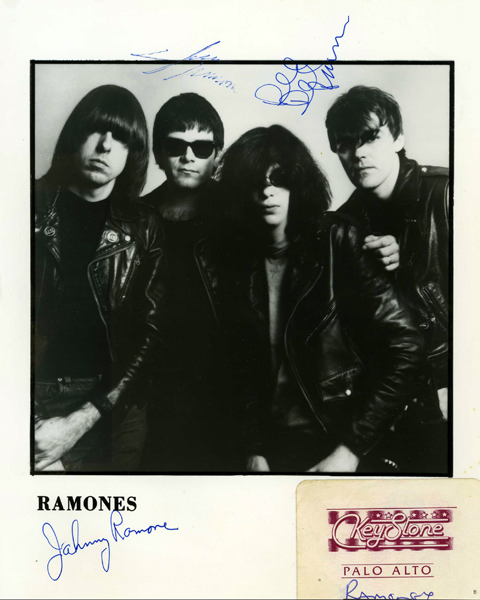
--from Rock: The Rough Guide I don't know quite what I'd expected when I found I was about to meet the Ramones the first time. I mean, I'd met up with their reputation before I'd ever met any of them in the flesh, and that reputation was pretty mean. People, lots of people, even told me they were glue sniffers, and that Joey was really crazy/stupid/wet his bed… and someone even told me that they hated women and pushed them down the stairs. So, I get this call from Stretch, music director at KFJC: "My car broke down. Can you pick them up at the club at the Keystone and bring 'em on up to the station for their on-air interview?" Well, Warner Bros had already asked if I wanted to interview them, so I figured it would be extra background for a story I was gonna write anyway. And it never hurt to do the local college radio station a favor.
When I get to the club, there's a serious air of doom. Their equipment truck had been stolen the night before in LA. Johnny and Dee Dee didn't want to talk about it much—they'd lost all their equipment, and worse, their original leather jackets. Things you can't replace, things that evoke the early days. Joey stood off by himself, sort of swinging his arms back and forth and being distinctly, well, strange. Talking to nobody. At the record store earlier that afternoon, I heard, it had been the same thing. A solitary spectre. Driving back from the radio interview, Dee Dee asked me who I wanted to interview later. I said, "Well, I've already listened to you and Johnny being interviewed and we've been talking in the car (they'd told me that working with Phil Spector had been a nightmare, the man is seriously crazy and had pulled a gun on them--Dee Dee is telling me this but Johnny is squirming, he definitely does not want to talk about the gun incident (Johnny is the "business" guy in the band). "Oh, he talks lots," Johnny assured me, while successfully changing the topic. We wound up sitting on a couch in the club owner's office, Joey peering at me with one brown eye over the top of his sunglasses. JOEY: When we started, we were all disgusted with everything on the radio and the state of rock and all the b.s. It wasn't what we grew up with, and it wasn't what we loved and knew as rock. It wasn't Elvis and it wasn't the '60s, the revolutionary time in the history of rock'n'roll, when so many different styles and things went down and were accepted. Even the Trashmen were accepted. There was the psychedelic thing and T. Rex. In the early '70s there were The Stooges and Elevator, but after '73 or so there was nothing but disco shit, even heavy metal had a corporate sound—The Eagles, The Doobie Brothers... There was no more rock'n'roll music. Everything was safe. Q: Easy listening. JOEY: Yeah. The easy listening thing was being pushed on us, where everybody was supposed to partake—your mother, your father, your sister and brother. Like, everybody was supposed to sit in the living room and listen to Meatloaf records together. So we were just completely disgusted. We all knew each other and had lived in the same radius and met in an elevator and decided that we were going to do this. When we started, we didn't consider what we were doing as "punk," but we had a song, "Judy Is a Punk Rocker," so the press started labeling it as punk. I don't know how we got signed in '75, because the New York Dolls had left a black mark on New York and no bands got signed because The Dolls never made it. But, we got signed to Sire, a small label, as a punk band and we put a single out in '76.
Q: You played the punk clubs, like lower Manhattan's CBGB's, and drew about a hundred people in your home base. JOEY: Yeah. But we went to England in July of '76 and we drew 3,000 at The Roundhouse and sold out everywhere. We were attracting all this royalty and all the people who would later become The Sex Pistols and the rest. They came to sound check and told us they formed their bands after hearing our album [Ramones]. When we left England, the whole British punk scene kicked off. Q: So, why didn't you get the credit for starting the punk thing, instead of ...? JOEY: Because we didn't stab ourselves and shit on stage and poke out our eyelids with safety pins. We didn't strangle each other on stage and mutilate each other with bats and stuff like that! Q: You didn't think that was necessary? JOEY: What we were doing was changing the course of rock history and changing culture and changing people's lives and bringing back the rock'n'roll music that we'd lost. These other groups had nothing to offer but the shock visual, "Let's kill each other here; everything sucks, the world sucks, and everything's negative." Q: But you don't feel that way? JOEY: No. I think the world's great and everything is wonderful. We're a very positive group. What does Duran Duran have to offer anybody, or Styx or Journey? How are they affecting your life, how are they changing your life, how are they giving you insights into your life? How are they making you a better person? What have they done for you? That's why those bands don't exist anymore. I mean, I thought The Sex Pistols were a great band, but they were a manufactured band. Malcolm McClaren put them together. It was his genius. He said, "Oh, I own a clothing store. Yeah, well now, I can sell more clothes. I'll dress them up and call them The Sex Pistols and put safety pins in their eyeballs and I'll make a fortune." I'm talking about the bands today, too. Q: They were marketed commodities. But, you did it on your own. JOEY: We didn't have any clothing stores behind us. Bloomingdale's wasn't behind us. Q: These days, you're getting played on MTV and the stations out here that are going to the "new music" format. JOEY: Yeah, it's nice that people are finally walking up and saying "Yeah" to the Ramones. So, like, the Van Halen and Ozzie Osbourne types are getting into us, too, the hardcore kids are into us and the college crowd. All kinds of people, all ages. Q: How do you feel about becoming an accepted entity after all these years? Doesn't it conflict with your "anti" image? JOEY: No, we're not anti anything. Actually, we wanted to keep rock'n'roll alive from the beginning. Rock'n'roll didn't exist anymore, and we wanted to bring it back. We were probably the only band that wanted to keep it going and that's why it's taken us so long. Because the establishment that didn't want us to exist used every effort to repress our music and, later on, the music of The Sex Pistols. They didn't want their empire shaken; everybody was very comfortable up there. Even now, with Men At Work and Flock of Seagulls—I mean, that's still shit, but I'd rather... I guess, if it's got to be them or Foreigner, then maybe I'd rather see them. At least the audience has accepted something new. Actually, though, I'd rather listen to Van Halen than Duran Duran any day. Q: Why is that? JOEY: I find them exciting, and they're amusing, and they're not stuffy. They'll take their clothes off and they're not so serious and they have a good time. They're entertaining; I like them. I need some excitement. I can't listen to Culture Club, you know. I like Cheap Trick and some of the local New York bands, a band called Schrapnel, The Rattlers, and I like Sparks—they're good friends of mine. And I like some of the English bands. Q: Earlier today, Johnny and Dee Dee were saying that you have a new video, "Psychotherapy."
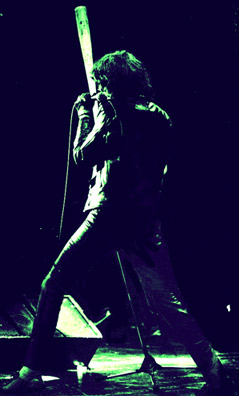
JOEY: And it got banned on MTV, which is really sick. It's supposed to be too violent, but actually it's not, it's just very tense. I think it's great, a real piece of art, a concept piece. I don't know, MTV is like white bread, you know—they claim to be a "new music" station and that they're doing something revolutionary, but that's bullshit! On the other hand, they're great, what they are doing is the greatest thing that could happen for the music business because it's on nationally. In places where it's the same Top 10 every 15 minutes and nothing new ever gets exposed on the radio, it's great. It could be a lot better; I mean, if the VJs knew what they were talking about, if they had any kind of knowledge about rock music, that would be very nice. They claim to be a new music station and they they ban something like our video. It's ridiculous, but, yes, we are going to edit it. Q: Are you going to stay like you are? JOEY: Well, after nine years, if we haven't changed yet, I don't think we're about to change. If we don't sound like The Police by now, I don't thing we'll every change. Their long-time, rather harried looking manager, Danny Fields, was sent away twice, but the third time he won out—the bus was sitting in the parking lot, engine running, and everyone and everything was loaded, waiting only for Joey. Twenty minutes after we began talking, he was—literally—dragged onto the tour bus. I figured that was probably the last time we'd talk, but that's not how it turned out. Backstage in San Francisco, I walked up to him, took my ego in my hands, and said, "Hi, I interviewed you about a year-and-a-half ago...." He peered at me through those ever-present sunglasses. "I remember," he said at last. And invited me to the show at The Cabaret in west San Jose, where old-time rancher money meets Silicon Valley nouveau riche. We'd talk on tape, he promised. But when I got there, he was in a lousy mood. Dee Dee glared out from the smoke on stage, Joey's straddled legs and gloved hand in the background. The local rich-punk population tried to throw itself on and off the stage in the now infamous head-first dive into the thrashing crowd. "Wow, it's just like the old days in England," Joey enthused after the show, and in a much better mood. "Meet me at the hotel in an hour, and we'll talk. But only off the record." We talked for hours—that interview tape and the transcript, alas, are lost—but my most vivid memory is of the incongruity of talking almost 'til dawn with the front man of the founders of punk, seated in a thoroughly upper-middle-class businessman's hotel, a pseudo-Spanish-style bastion of respectability. With a parrot squawking away in the background. The parrot got more attention from guests at the hotel than did the torn-jeans-and-leather-clad Joey. "I stopped being mature," Joey was once again peering at me over his shades. "I never want to be mature. I'm content. I'm enjoying myself." |